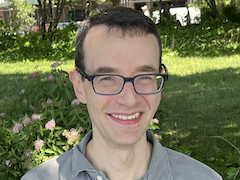
picture of Andrew Goldstone

I am an Associate Professor in the Department of English at Rutgers University, New Brunswick. I work on twentieth-century literature. My research interests include genre fiction, the sociology of literature, modernism, and the digital humanities. I am the author of Fictions of Autonomy: Modernism from Wilde to de Man (Oxford University Press, 2013).

  • CV
  • github
  • mastodon
  • bookwyrm
  • a 🥟 progress
  • rss

Upcoming

ACLA Seminar in Providence: Bad Reception

Anyone attending the ACLA 2012 conference in Providence at the end of this month is warmly invited to come join some or all of the seminar I have organized with Harris Feinsod on Bad Reception, Missed Connection, Clogged Circulation. We will be meeting at the invigorating hour of 8 a.m. from March 30 to April 1 in the Roberts Center, Room 225. The presentations are:

Friday, March 30

Katherine Mannheimer, University of Rochester
“The Rash Dexterity of Wit: Genre-Hopping Verbal Patterns in Restoration Drama and Poetry”
Molly Swift Metherd, Saint Mary’s College of California
“The Great Canal Race: US and Japanese Imperialism in James Weldon Johnson’s El Presidente, or The Yellow Peril”
Anne DeWitt, Princeton University
“Reading Reception of the Theological Romance”
Harris Feinsod, Northwestern University
“Modernism Aship: Recirculating Transnational Poetics”

Saturday, March 31

Andrew Goldstone, Eugene Lang College The New School for Liberal Arts
“The Song of Misrecognition: Indian Love Lyrics in Yeats, Tagore, and Edith Hull” 
Sonam Singh, Cornell University
“The Bad Reception of the 1930s Anglophone Indian Novel: Politics, Aesthetics, and the Frameworks of Postcolonial and Modernist Studies”
Gabriele S. Hayden, Reed College
“Performing Blackness in Weimar Germany”

Sunday, April 1

Luke Parker, Stanford University
“Emigration, Backwardness, and the Search for an Alternative Present: Russian and American Writers in Interwar Europe”
Lee Konstantinou, Princeton University
“Bad Attitude: William S. Burroughs at the Birth of Punk”
Meredith Ramirez Talusan, Cornell University
“Negritude Without Filitude: Form, Language, and Possibilities of Reception in Modern Filipino Poetry”
Daniel R. Mintz, University of Michigan
“Bildung Towards the End: Kermode’s Mythic Temporality and Doctorow’s Book of Daniel”

Funny old thing (LaTeX class for Yale PhD thesis)

Here’s a funny thing. This is a LaTeX document class file for a Yale Ph.D. dissertation: mythesis.cls. When I submitted mine, I discovered an older document class other people had worked on, and tweaked it to bring it up to the 2006 spec. Might be useful for current Yalies (if they somehow find this page by googling) or others TeXing their dissertations. Invoke with \documentclass[12pt]{mythesis}.

I’m adding it to the small github repository in which I’m going to start keeping tex sources for people to play with.

Coming next: a document class/style file/sample source for a student paper. One day I am going to persuade a student to TeX a paper.

I can dream, anyway.

How to Begin

So you just want to begin. The TeX Users Group website has a Getting Started Page with the essentials: introductory documents, examples, and, most importantly, links to the software itself: TeX Live on Unix, MacTeX on Mac, proTeXt on Windows (all free, and rather enormous, downloads). If you are on a Mac, look for the TeXShop application; if you are on Windows, look for TeXnicCenter. If Unix, pffft; open up an xterm and vim/emacs. However you do things, here is a file to start playing around with: xelatex.sample.tex. If your setup is working like mine—and if you have the fonts I use—you should be able to typeset it with XeLaTeX and get a result that looks like this: xelatex.sample.pdf.

read more…

Site update

After a satisfying experience building my spring 2012 course site using jekyll, I’ve converted this site over to jekyll too. I took the opportunity to make some minor changes and updates to the site content here and there. Please contact me if you find problems on the site.

ACLA 2012

I am organizing a seminar for ACLA 2012 (March 29–April 1 at Brown) with Northwestern’s Harris Feinsod on Bad Reception, Missed Connection, Clogged Circulation. This seminar is devoted to the ships in the night of literary history: the near misses, the affinities that should have formed but didn’t, the treacherous reception contexts that betrayed the promise of circulation. How can focusing on these blockages and (to use a term of Roland Greene’s) obversals enrich and complicate comparative literary study? As for my own paper, in a cross-over between two research interests of mine, the role of popular genres in the early twentieth century and the history of Indian writing in English, I’ll be discussing “Indian Love Lyrics” from Yeats to Tagore to E.M. Hull. I may or may not learn to sing the “Kashmiri Song” by Amy Woodforde-Finden.

biber first aid for “data source not found”

I don’t know what causes it, but every now and then biber gives up working on my system. Then I start getting error messages like data source /var/folders/m6/bn7r45zx6cx55rr9g4qh6s6w0000gn/T/par-agoldst/cache-87e533530c5239fb9f8e3ff008979f1f16ea0e5e//inc/lib/Biber/LaTeX/recode_data.xml not found in .

There is a magic incantation, which I found somewhere on the biber sourceforge forums, to get biber to clear the cobwebs by reinstalling itself using perl’s PAR tool, as it does the first time it is run on a new system. Just clear the PAR cache, whose location under /var is helpfully specified in the error message:

 sudo rm -rf /var/folders/m6/bn7r45zx6cx55rr9g4qh6s6w0000gn/T/par-agoldst

You will have different stuff in /var/folders.../par-<username>.

Since I’ve seen other people complaining of this, I’m convinced it’s not my fault but the result of some deeply buried sporadic bug in biber. I’d try harder to figure it out, but it’s just too easy to make this one go away when it pops up once every few months. TeX is hacking, people!

LaTeX to Word: the basic issue

It seems to me that there are two possible avenues for the challenge of converting LaTeX source to Microsoft Word—a challenge which humanists will have to take up whenever they collaborate with non-TeXnical co-authors and editors. One route is to parse the source and output Word or, more likely, a less closed intermediate markup format. Humanists are actually better off here than scientists, since they don’t use the major feature that TeX handles very differently from word processors—and far, far better: namely, mathematical equation typesetting. And assuming that Word is not going to be the format for final publication, there’s no need to cry (much) over the loss of typographical quality resulting from subjecting your paragraphs to Word’s justification and pagination “algorithms” rather than TeX’s. The goal is most likely just to share and edit content. For these purposes (from shared authorship to substantial editing to copy-editing), LaTeX markup for humanists can be pretty simple—indeed, practically equivalent to the text-markup subset of HTML itself: paragraph, header, section (division), span. For this very minimal version of LaTeX—entirely conceivable as a possibility for humanists—conversion to Word is a matter of getting a parser for the minimal LaTeX and outputting its equivalent in XML.

read more…