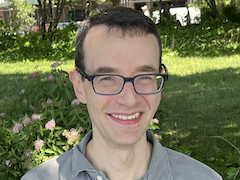
picture of Andrew Goldstone

I am an Associate Professor in the Department of English at Rutgers University, New Brunswick. I work on twentieth-century literature. My research interests include genre fiction, the sociology of literature, modernism, and the digital humanities. I am the author of Fictions of Autonomy: Modernism from Wilde to de Man (Oxford University Press, 2013).

  • CV
  • github
  • mastodon
  • bookwyrm
  • a 🥟 progress
  • rss

Upcoming

Two Upcoming Events

Two announcements of events I’m involved in, transpiring in the week after next:

Princeton Digital Humanities Initiative: Roundtable (3/26)

I’ll be joining a group of people at a Princeton Digital Humanities Initiative Graduate Student Outreach. It’s March 26 at 4:30 p.m. in Frist Multipurpose Room C. I’ll talk a bit about the PMLA topic models Ted Underwood and I are working on.

Rutgers: Lecture by Jim English (3/28)

The Rutgers Modernism and Globalization Seminar Series, which I am running this year, is hosting a guest lecture by James F. English of Penn on Thursday, March 28:

Modernism and Globalization Seminar Series

James F. English
John Welsh Centennial Professor of English
University of Pennsylvania

Not Now: Empirical Method and Default Temporality in Contemporary Fiction

Thursday, March 28, 2013, at 4:30 p.m.
Murray Hall, Room 302, 510 George Street
Reception to follow at the Center for Cultural Analysis, 8 Bishop Place
Free and open to the public

Abstract: This paper is mainly concerned with methodological challenges involved in using digital methods and big data in the field of contemporary fiction. It sketches an early-stage “small data” research project and presents some initial empirical (quantitative) results having to do with the temporal settings of Anglophone novels since 1969. These findings then provide an occasion to consider some possible reasons for a shift in the default temporality of the novel, and some possible implications of surface reading with respect to novels that eschew the present in favor of the past, the future, and the temporally queer.

James F. English is the author of The Economy of Prestige (Harvard, 2005) and The Global Future of English Studies (Blackwell, 2012), and Director of the Penn Humanities Forum.

Co-sponsored by the English Department, the Center for Cultural Analysis, and the Rutgers British Studies Center.

[Edit 3/18/13: RBSC link fixed.]

Remarks to the Comparative Modernisms Workshop at Northwestern

Yesterday I had a great discussion with the Comparative Modernisms Workshop at Northwestern about my book, Fictions of Autonomy. I’m grateful to Harris Feinsod and Rebecca Johnson for the invitation and for facilitating such a lively event. I was particularly pleased to have had undergraduates from the lit-theory interest group (with excellent, searching questions) as well as grads and faculty at the discussion. Everyone who read my book had generous-spirited, thoughtful things to say. May my book find more such readers.

After the jump, a lightly edited version of my introductory remarks, plus a little esprit de l’escalier.

read more…

Monday: Discussing My Book at Northwestern

One more reminder: I’ll be discussing my new book, Fictions of Autonomy: Modernism from Wilde to de Man, with the Comparative Modernisms Workshop at Northwestern University tomorrow, Monday, January 14.

The discussion will be held at 5:15 p.m. in the Seminar Room at the Kaplan Institute for the Humanities (Kresge Hall 2-370; map). Contact Prof. Harris Feinsod for copies of the advance reading from the book.

After the event I’ll post my introductory remarks on this blog.

LaTeX and My Book: Postscript

So now that my book is in print (read it! buying links on the book page!), I wanted to indulge an urge to look back at the technical, or rather TeXnical, aspects of producing the book. I had the quixotic determination to write the book in LaTeX and to take advantage of what LaTeX can do right through production, and, through the hard work of various parties at Oxford U.P., I had the chance to do so.

This is going to be a nerdy post. You’ve been warned. I’ve also added an equally nerdy e-colophon page describing the technology I used to make the book.

read more…

Book event at Northwestern, January 14

On Monday, January 14, 2013, I’ll be discussing my new book, Fictions of Autonomy: Modernism from Wilde to de Man, with the Comparative Modernisms Workshop at Northwestern University. Copies of the book will be available at the event.

The discussion will be held at 5 p.m. in the Kaplan Humanities Institute Seminar Room (Kresge Hall 2-370). Contact Prof. Harris Feinsod for copies of the advance reading from the book.

[Edit 1/3/13: added room info.]

Topic-Modeling PMLA

This post is co-written by Andrew Goldstone and Ted Underwood. It is cross-posted at The Stone and the Shell and Arcade. Update, July 2026: the Arcade version lost links to figures, and JSTOR Data for Analysis is long gone, but the images hosted at Ted's website are still around and linked here, as is, amazingly, the interactive image map linked from the first figure below.

Of all our literary-historical narratives it is the history of criticism itself that seems most wedded to a stodgy history-of-ideas approach—narrating change through a succession of stars or contending schools. While scholars like John Guillory and Gerald Graff have produced subtler models of disciplinary history, we could still do more to complicate the narratives that organize our discipline's understanding of itself.

A browsable network based on Underwood's model of PMLA is available at [pmla.site44.com](http://pmla.site44.com).

A browsable network based on Underwood’s model of PMLA is available at pmla.site44.com.

The archive of scholarship is also, unlike many twentieth-century archives, digitized and available for "distant reading." Much of what we need is available through JSTOR’s Data for Research API. So last summer it occurred to a group of us that topic modeling PMLA might provide a new perspective on the history of literary studies. Although Goldstone and Underwood are writing this post, the impetus for the project also came from Natalia Cecire, Brian Croxall, and Roger Whitson, who may do deeper dives into specific aspects of this archive in the near future.

read more…