For a troublingly long while I have been almost finished with an update to my software for exploring topic models, which consists of an R package, dfrtopics, and a JavaScript thingy, dfr-browser. This update is focused on making it easier to look at a single topic model more than one way or to toggle between topic models of identical or related corpora. Experience suggests that producing and interpreting even one useful topic model of a corpus is so much work that many people, myself included, are tempted to stop short of comparing the outputs of multiple models, even though this is an important way of checking that patterns revealed by any model are not purely artifacts.

I am an Associate Professor in the Department of English at Rutgers University, New Brunswick. I work on twentieth-century literature. My research interests include genre fiction, the sociology of literature, modernism, and the digital humanities. I am the author of Fictions of Autonomy: Modernism from Wilde to de Man (Oxford University Press, 2013).
Upcoming
- July–December, 2026. Clare Hall, Cambridge. Visiting Fellow.
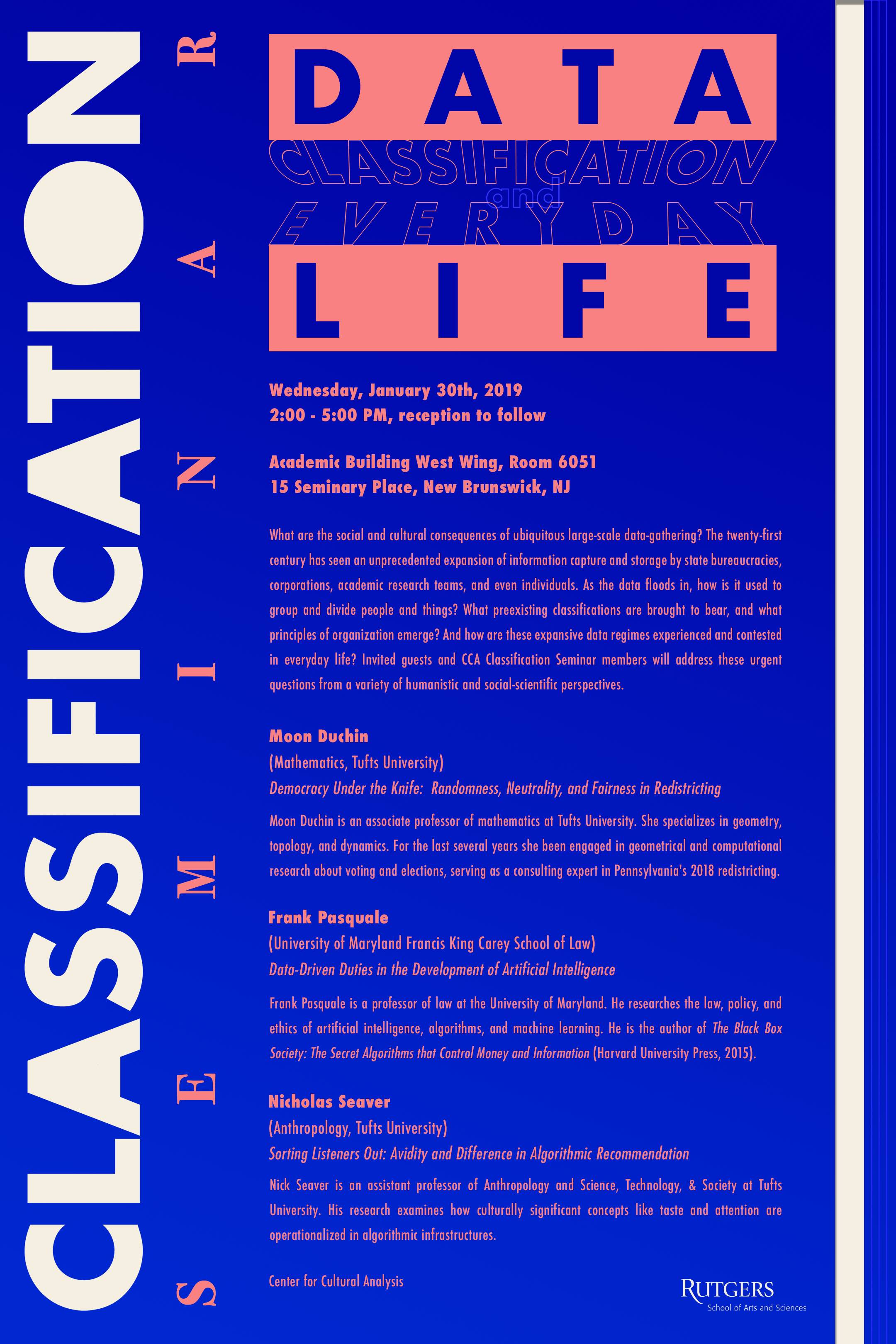
Next week at Rutgers: Data, Classification, and Everyday Life
Next Wednesday, the yearlong seminar on classification which I am co-organizing at the Rutgers Center for Cultural Analysis is hosting a one-day symposium on “Data, Classification, and Everyday Life.” We have three exciting guests and a plan to take over the world.
Modernist Studies Without Modernism: Preprint
About a decade ago—painful words to type—I started working on an empirical study of the bibliography of scholarship on modernism. I intended it to be a quick side-project, maybe a piece of an essay or a book introduction, that would bolster my theoretical argument for alternatives to “modernism” as a period concept for studies of the twentieth century. It was also my first foray into quantitative work, which possibly explains why it has seemed to need so many further iterations since then. In any case, I now have an essay version, which I call “Modernist Studies without Modernism,” which I am ready to make public. I have posted it to an Open Science Framework repository which also points to a reproducibility archive with R markdown source code for the essay and (processed and cleaned) data.
Microblog 5: neoliberalism, a primer
Many people are confused about what neoliberalism is. Here, for their reference, is a thing that is definitely neoliberalism. I received a letter from the State of New Jersey Division of Pensions and Benefits informing me that the state employee health plan would be undergoing a “dependent eligibility verification audit.” Every NJ employee who has children or other dependents on their health insurance is going to have to prove that those dependents are eligible. The reason, says the letter, is that “the cost of coverage for dependents… is substantial, and coverage of ineligible individuals unfairly raises the costs of coverage for all members and taxpayers.”
The first thing about this that is quite neoliberal is the idea that I, a “member and taxpayer,” should be mad about the dollar cost to me of other NJ employees’ kids having health insurance when they don’t “deserve” it, and that “fairness” will only have been achieved when I and all other “taxpayers” am only sharing the cost of health insurance for people who do deserve it. But since I actually think that everybody deserves health care, I can’t get mad about ineligible dependents; what I do get mad about is the lack of universal health care. I also get mad about receiving this letter, the rhetoric of which converges with the hard-right case against Medicare for all, on letterhead with the name of New Jersey’s new, supposedly “progressive” governor on it. But that is the second thing that is neoliberal about this: it exemplifies the full complicity of politically liberal parties in transforming all social rights into private goods and limiting the state’s responsibility to ensuring “fair” trading conditions in those newly marketized goods.
But best and most neoliberal of all is that this dependent eligibility verification audit is not being carried out by state employees; no, for the state Division of Pensions and Benefits has “engaged the services of Alight Dependent Verification Services” (which of course also means that “members and taxpayers” are paying for these services; they are also paying for the time all the state employees like me are going to have to waste proving they are actually married to or parents of the people they are married to or parents of). Alight Solutions LLC, “a leading provider of human capital solutions,” has a business in helping organizations kick people off health insurance. Under neoliberalism, the state of New Jersey is just one more client, ipso facto pursuing the same goals Alight pitches to all potential clients on its website: “return on investment,” “fiduciary responsibility,” and decreased “compliance risk.”
There you go: it’s pretty neoliberal, is what I am saying. Very happy holidays to all the responsible fiduciaries in Trenton and their no doubt fully benefits-eligible families.
Microblog 4
Just an addendum to my last post on declining humanities majors. Thinking of this trend in terms of student preferences (however formed) prevents us from thinking about which students are enrolling. That is to say, selective colleges and universities make choices about which students to admit, and there is a “political economy of enrollment”: since students are accounted sources of revenue, how many of them there are and where they go is crucial to the distribution of resources in the university. This distribution is of course not left entirely up to students themselves.
Microblog 3
The internet moves at such a rapid pace these days that I can read and comment on a piece in the Altantic less than four months after it first appears. Having fixed my RSS reader’s link to Ben Schmidt’s blog (and yes, remarks about my RSS reader are going to be a fixture on my microblog) I now catch wind at last of his truly marvelous essay on the crisis in humanities majors from August, building on a less formal and somewhat more pungent blog post from July. Ben’s series on the issue continued more recently with a piece for the AHA magazine, The History BA since the Great Recession. This last reveals that for once history may be the new humanities crisis champs, since they have seen the largest proportional drop in majors nationally since 2011. Of course they had further to fall than long-term crisis heavyweight English; English degrees were already on the decline, having made less of a rebound from their previous trough than other humanities fields. Neither English nor history nor any of the other long-standing humanities fields have hit bottom by any means; Ben shows that the rate of decline may just be beginning to decrease, but this will be small consolation to those of us who work in these fields.
Characteristically for Ben, these are all beautifully executed pieces of reasoning with data. The Atlantic essay is also gorgeously presented (and comes with a reproduction repository!). I particularly liked, too, the idea of counting BA degrees as a share of the 23-year-old population, which avoids what is so misleading about the “share of degrees” measure most people focus on to talk about a humanities crisis, namely, that the college-age and college-going populations are both still growing. The news for humanities majors is bad, however, whatever measure you follow, even raw degree numbers.
Ben has a reasonable discussion of how to interpret this evidence. The onset of the Great Recession really is a turning point, and it looks to be the only explanatory factor with the right timing and the right scale (that is, national, across all institution types and populations). Ben quite carefully speaks of “student priorities…formed even before they see the inside of a college classroom.” Naturally the formation of such priorities does not take place in a vacuum, and it is good to remember that what students choose is not necessarily what they would choose if they felt unconstrained—and if they knew all there was to be known about what they were choosing. The choices are not particularly rational in terms of expected future earnings, but they probably do give evidence of a widespread pressure to make a “practical” choice, where this is understood to mean choosing a preprofessional, technical, or scientific major.
As usual my feeling is that “defending the humanities” is a terrible response to this situation (and not one that Ben advocates either). Free college for all would be a better one. Or—as I also always say—refunding public K–12 education.
It is not just the humanities that are losing students, and we see again the emergence of cleavages in the system of higher education that differ from the pre-WWII tripartion into humanities, sciences, and social sciences. “Fields in closer proximity to the humanities,” says Ben, have also lost majors (absolutely and by share): anthropology, sociology, political science… The field of communication has not declined in the same way; neither has psychology (where it is easy to imagine preprofessional possibilities). It’s tempting, but probably English-centric, to remark that the losers are all fields in which students read and write a lot.
Finally, however things look from the student and faculty positions, it’s worth remembering that the “crisis” in the humanities is likely no such thing from the position of ruling elites and the people who manage universities for them. To them it must look like an improvement, from the perspective of short-term economic development, in the mixture of human capital being produced by higher education. It is also indisputably a chance to dispense with some more tenure lines in disciplines whose only contribution to institutional revenue is teaching—and which tend to produce the most annoying gadflies on the faculty to boot. Even if administrators understood that humanities tuition dollars actually subsidize the sciences, they would reason that they could rake in those same tuition dollars on the backs of adjuncts and NTTs, especially if all those enrollments are people doing gen-ed requirements rather than majors.
Noted, for future bloggery. The MLA actually did follow up on the “Where Are They Now?” study I looked at last year with a report, The Career Paths of Modern Language PhDs.
Microblog 2
It’s always a pleasure when my RSS reader brings me posts from one of my favorite academic bloggers, Cosma Shalizi. His “blogospheric navel-gazing” comes with a justifiably melancholy prefatory note about the medium and its displacement by corporate social media. I notice that the Blogging Advice to the Young Scholar genre takes a somewhat different form when its imagined addressee is a scientist than when it is a humanist. The whole question of communicating expert knowledge to a public looks different when you are not in one of those fields that everybody already knows everything about (which would be my working definition of the humanities, capturing perhaps the only thing literary studies, history, philosophy, etc. really have in common). But really my favorite Shalizi blogging is his slightly-more-than-tweet-sized comments on his voluminous reading.
I forbear commentary here on the local news related to saying things on the internet, but the national AAUP’s letter on the matter pointed me to some interesting local history which is also a key stage in the development, if that is the word, of the institution of the right-wing troll mob. In April 1965, Eugene Genovese, then a recently tenured associate professor at Rutgers (cough cough), affirmed at a teach-in on Vietnam that, as “a Marxist and a socialist,” he would “welcome” a Viet Cong victory. The young Republicans, the Republican gubernatorial candidate, and eventually Richard Nixon all went after Genovese, trying to get him fired. B. Robert Kreiser’s detailed account of the episode for the 2016 issue of the Journal of Academic Freedom is full of amusing details: “Scarlet and black bumper stickers with the slogan ‘Rid Rutgers of Reds’ could be seen on an increasing number of New Jersey automobiles” (14). The whole performance—the pantomime righteous indignation, the media scandal-mongering—is very resonant with our moment. Less resonant is the response of the senior administrators of Rutgers and the incumbent Democratic governor at the time, all of whom managed to defend Genovese pretty consistently on the basis of his academic freedom and free-speech rights, as well as the autonomy of the university. Imagine, state elites defending a left-wing professor using a public-good understanding of the university! Their stance bespeaks a kind of confidence in the standing of the university and the sources of that standing among the public that is hard to find in our neoliberal present.
In self-promotion news, I’ll be at Penn State next week to join in the Information + Humanities Conference. And all this year I am co-leading the Annual Seminar at the Rutgers Center for Cultural Analysis, on the theme of classification. Hoping to micro- or even macro-blog about it as the year goes on.
Microblog 1
I may be on an extended holiday from twitter, but it struck me that blog technology is fully capable of posting links to things and commenting on them. It’s like my blog is my very own microblogging service! If you want to catch all the microupdates, just subscribe to my RSS feed! (I don’t promise that this first microupdate won’t also be the last, but for the honor of The Web We Lost, I’ll try.)
Here under my rock, I had missed the academic scandal of the hour. As Natalia Cecire rightly says, “It’s such a betrayal when real expertise becomes a warrant for demanding deference instead of a pedagogical responsibility.” Read her post and learn about learning.
I also appreciated Corey Robin’s comment in the Chronicle Review (currently unpaywalled). I find stories of academic abuse of power, sexual and otherwise, so sickening that I don’t have the energy to seek out any more details just now. But nothing ever surprises me less than senior academics closing ranks against their juniors: we are talking about a profession that has been concertedly devouring its young for half a century…. The deformation of the deprofessionalizing academic profession is another object of what Natalia aptly terms “emergency learning.”
Edited the same day: also, on my microblogging service you can edit your posts to fix typos.
The Uncounted: Jobs and Graduates
The MLA’s preliminary report on the 2016–2017 Job Information List is out, with the predictable and disheartening finding that job listings in both English and modern languages are down to another all-time low. Actually the situation is worse than the report’s first chart suggests, since the proportion of tenure-track positions has also been on a steady decline. Meanwhile the number of new PhDs in English is largely steady.
Casualization Sensation
The Guardian, as part of its “Outside in America” series on homelessness, has published a feature about homeless adjunct instructors by Alastair Gee. It is painful reading. The protagonists of the story include a homeless English adjunct professor at San Jose State and an anonymous adjunct who pays the bills through sex work.