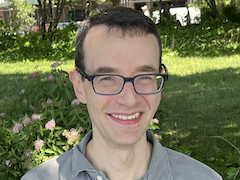
picture of Andrew Goldstone

I am an Associate Professor in the Department of English at Rutgers University, New Brunswick. I work on twentieth-century literature. My research interests include genre fiction, the sociology of literature, modernism, and the digital humanities. I am the author of Fictions of Autonomy: Modernism from Wilde to de Man (Oxford University Press, 2013).

  • CV
  • github
  • mastodon
  • bookwyrm
  • a 🥟 progress
  • rss

Upcoming

At DH 2014

Update, July 11, 2014: my slides are here: slides.pdf. The R code used to generate material in the slides is available in a gist.

Update, July 2026: the online archive of abstracts from the conference has been ruined, so I removed links my and others’ abstracts. They can be found, however, in the PDF of the proceedings.

I’m attending the Digital Humanities 2014 conference in Lausanne next week. If you’re around Lausanne next Friday, my talk, titled “Let DH Be Sociological!,” is part of a panel at 11 a.m. in 415 Amphimax. This paper builds on my work using topic models to analyze the history of literary scholarship, but takes a more polemical tack. I’ll use my ten minutes to argue that the moment of “DH” represents a critical opportunity for bringing literary studies (and perhaps other humanities) closer to the social sciences.

read more…

The Quiet Transformations of Literary Studies

My article with Ted Underwood on the long-term history of literary studies is now available in a preprint form (pdf). This essay will appear in NLH, but the publisher has kindly given permission for us to make a submitted manuscript available now. Please keep your eyes open for the final published version. It’s been a long (though enjoyable) journey from our initial exploratory blog post in late 2012 to this essay.

The article’s primary evidence is a topic model of seven scholarly journals in literary studies that span the last century and a bit more. In order to make this form of evidence more accessible, I designed a website that allows you to explore the model. Ted and I spent a long time exploring the many, many different ways you can slice and dice topic models before arriving at the claims we make in the essay. To get a sense of how we might have gotten there, spend some time surfing the model, seeing both its power to reveal and its inevitable froth of randomness and approximation. And, hopefully, you’ll discover patterns of your own.

What I’m most proud of in our essay is our effort to show why our approach responds to central questions in literary history and literary theory. We are interested in topic modeling in itself, but I see our essay as aiming primarily at two things. We try to revise literary scholarship’s conception of its own history. And we argue that quantitative methodologies in literary history, far from dispensing with interpretation, attempt to scale up the interpretation of cultural texts while keeping the major problems of interpretation in view. This scaling-up tends to bring humanistic scholarship into closer proximity to the challenges and methodologies of the social sciences.

I’m planning to expand on that last claim in my talk at DH 2014…. Ted’s and my joint formulations are in the essay. Read it, and browse the website.

After the jump, the rest of this post is all geeking out about programming and workflows.

read more…

Fall 2014 Courses

Now that fall 2014 course registration has started, I have put descriptions of my fall courses up on the teaching page. I am offering Early Twentieth-Century Fiction (formerly known as Twentieth-Century Fiction I), my take on literary modernism and literary modernity in English; for more about that course, take a look at the syllabus of the 2013 version. I’m also very excited to be teaching a literary theory seminar. Here’s the brief description (the full syllabus will be posted in the summer):

The Social Construction of Literature

Where does literature come from? Many discussions about literature proceed as if this question hardly matters: the text, say the teachers and the critics, is there, and we only need to read it closely enough to discover its meaning. But who put the text there, who said that it was literature, and who is this “we” who is doing the reading? Once we ask these questions, we have begun to think of “literature” as a social construction. The goal of the course is to enrich the way we think about literature by understanding the arguments in literary studies’ debates, from the early twentieth century to present, about the relationship between literature and society. Central themes of the course include: literary form and the rejection of social context; literature as socially oppositional force; literature and political power, especially the power of the European empires; the debate over the literary canon and the role of educational institutions; and sociological theories of the literary field. The readings in this course are challenging but highly rewarding. Seminar discussion concentrates on patient engagement with theorists including John Crowe Ransom, Theodor Adorno, Raymond Williams, Edward Said, Pierre Bourdieu, Mary Poovey, John Guillory, and Pascale Casanova. We also work with the theories in literary case studies, which may include poetry by Langston Hughes, W. H. Auden, and Elizabeth Bishop; short stories by James Joyce and R. K. Narayan; an exploration of the history of Rutgers course catalogues; and an analysis of literary prizes. Requirements: active class participation, regular informal writing, two short papers, and a medium-length term paper, which will be submitted in both draft and final forms.

I cannot forbear remarking that this course is also a requirement-fulfilling bonanza: English majors can simultaneously fulfill the theory and seminar (400-level) requirements; they can also fulfill the WCr Core requirement. The course requires English 219 or 220 as a prerequisite.

Edit 8/15/14: course name change.
In Utrecht This Week: The Ethics of Literary Autonomy

This Thursday and Friday, I’m participating in a symposium on The Ethics of Literary Autonomy organized by Wilbert Smulders and Frans Ruiter at the University of Utrecht. The description of the event is here in Dutch; the full program is in English (pdf). I’m giving a lecture on Friday morning which I’m calling “Autonomy without Ethics: Strangers in the Literary Metropolis.” It’s based on my work in Fictions of Autonomy with some bonus material on G. V. Desani, because Desani.

Given that my principal theoretical claim is that artistic autonomy is always defined in relation to particular social and historical contexts, I’m particularly pleased to be discussing autonomy in contexts that will be quite new to me. I’ll try to post some notes on the symposium here after I return next week.

And if you’re in Utrecht, stop by…

The DH@RU Showcase

Tomorrow (Wednesday, January 29) is the Rutgers Digital Humanities Showcase. It’s a packed schedule of presentations demonstrating digital humanities work from all around the university. If you’re in the area, stop by Alexander Library’s Teleconference Lecture Hall. We’ll run from 2 p.m. to 6:30 p.m. Full schedule at dh.rutgers.edu/showcase. Free food at the end!

I’ll be giving a highly compressed demo of some of my work on topic-modeling and the history of literary studies. But the main reason to come is the revelation of the broad range of exciting digital and humanistic work that is in full swing at Rutgers.

Omnivorousness, Elite Taste, Literary Scholarship

Tacos al pastor, Mac laptop just out of view. Image CC-BY-SA 2.0 Paul Bailey, via Wikimedia Commons

Tacos al pastor, Mac laptop just out of view. Image CC-BY-SA 2.0 Paul Bailey, via Wikimedia Commons

Let’s talk about quantitative literary history and where you can find the best tacos al pastor.

I’ve been spending some time recently researching trends in the history of literary scholarship. For MLA this year, for a panel on “Seeing with Numbers” with Hoyt Long, Richard So, Matt Jockers, and Amy Hungerford, I was thinking about the drive to include more texts among our objects of study. On the panel we focused on efforts to see more of literary history by using quantitative methods.1 But as I was working on my analysis of the changing (or rather unchanging) distribution of scholarly attention in modernist studies, it occurred to me that it is not only the quantifiers in literary studies who articulate the impulse to include more texts.

read more…

At MLA 2014

Tomorrow at MLA, I’m participating in a panel on quantitative literary history and the sociology of literature. You can call it digital humanities if you want! You can call it modernist studies if you want! Personally, I call it…

Seeing with Numbers: Macroanalytic and Sociological Approaches to Literary Exclusion

Friday, January 10, 2014
10:15–11:30 a.m., Chicago F, Chicago Marriott
Presiding: Richard Jean So, University of Chicago

  1. Modernism’s Limits: Patterns of Exclusion in Scholarly Reading
    Andrew Goldstone

  2. Finding Thomas Curtis Clark: Topic Modeling the Rules of Exclusion in American Modernist Poetry
    Richard Jean So and Hoyt Long

  3. Response
    Matthew Jockers

  4. Response
    Amy Hungerford

I will post my slides on this site before (shortly before) the talk at andrewgoldstone.com/mla2014.

Workshop notes: Digital text

Over on dh.rutgers.edu, I’ve posted extensive notes from last week’s Empowerment Part II workshop on plain text formats like markdown, HTML, and LaTeX. I’ve also made available the set of sample files I used in the workshop, plus a few more. Those might be useful for others who might wish to learn any of those three languages or see what files converted from one to the other look like. I’ve put some time into making the workshop notes into something someone could work through on their own. For more about the files, see the workshop notes. For anyone interested in LaTeX, the template.tex file contained in that set of sample files supplies a starter template for a LaTeX document (it’s derived from the templates in my git repository of tex files). As a bonus I have also made available the markdown source used to generate both that workshop-notes webpage and the slideshow for the in-person version.1

You might reasonably ask: Why spend any time on this? Computer typesetting and the ins and outs of plain-text composition gadgets are very far from the center of the digital humanities. HTML is an important computer language in DH, but LaTeX is no such thing, and markdown is pretty rudimentary-seeming. Some thoughts on this over the fold…

read more…

DH Workshop Tomorrow: Empowerment Part II

Tomorrow I’m leading a digital humanities workshop at Rutgers.

Empowerment Part II: Digital Text

Wednesday, November 20, 1:10-3:10 p.m.
Alexander Library, Room 413
169 College Avenue, New Brunswick, NJ

This workshop aims to expand our horizons for thinking about how we handle text on our computers. In order to attain liberation from Word, we will explore the difference between text editors and word processors, discuss the ways computers represent text as content or form, and experiment with some key technologies for digital document preparation. We will dally with three related computer languages in rapid succession. We will begin with markdown, a minimal but versatile set of plain-text conventions. Then we will learn to convert markdown into equivalent HTML markup using Pandoc. Finally, we will introduce the LaTeX document-processing system, which elegantly typesets plain text into PDF files. No prior experience with any form of markup or other computer coding is required. E-mail Vishal Kamath to register (vkamath at scarletmail dot rutgers dot edu).

Naturally I will be riding my markdown and TeX hobby horses. But the actual “empowerment” (modest but real) comes in getting a more detailed understanding of the way the systems we already use handle text, and in learning more ways to manipulate that text, beyond the confines of any single program. The business of plain-text-slinging, a minor craft on its own, nonetheless forms a natural starting point for thinking more deeply about analyzing digitized texts, expressing yourself in “code” of various kinds, and composing in the digital medium.

Do Not Despair, Do Not Presume

A Cautionary Tale about JSTOR Data

A note of caution about working with text as data in the age of digital archives, and a note of caution about notes of caution.

“Raw data is an oxymoron”—as the title of a recent collection edited by Lisa Gitelman has it. Indeed yes. But what should this mean, in practice, for those who still want to aggregate data for analysis? Especially when the data in question is textual, and the analysis is meant to serve the scholarly study of culture? What do we do when the data is not only “cooked”—as all data is—but flawed? In this post, I want to suggest, as a twofold rule of thumb, one of Beckett’s favorite quotations: do not despair: one of the thieves was saved; do not presume: one of the thieves was damned.

read more…